


The digital landscape in 2025 is evolving at a rapid pace, and artificial intelligence is driving the shift in how search engine results are displayed. Answer engine optimization (AEO) is now at the forefront of every modern search engine marketing strategy.
In 2025, voice assistants, AI tools, and smart chatbots continue to dominate online search habits, having AEO has become central to every search engine marketing strategy.
What is AEO?
AEO is the optimization of content to give users an abridged, direct, concise factual answer to their queries across Artificial Intelligence (AI) powered platforms like ChatGPT, Perplexity, and Google AI Overviews. Whereas traditional SEO aimed for page rankings, AEO will focus on getting page answers, the answer is returned or read to the user from the AI systems. Users now search differently, using full, natural-language questions, often asked through voice.
Why is Answer Engine Optimization (AEO) Important?
The significance of answer engine optimization comes from how digital visibility has changed. Today users are not clicking through multiple links, they are expecting quick, reliable responses, courtesy of AI. This means brands have to change if they want to remain relevant. When AEO is utilized, websites can achieve top of the funnel positions in AI generated summaries or voice searches, improving trust, visibility, and conversion rates significantly. AEO works alongside more modern AI SEO optimization efforts by ensuring your content is structured, authoritative, and related to user intent.
What is the Difference Between AEO and SEO?
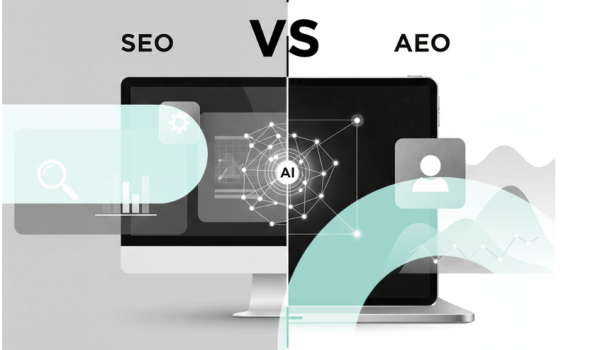
AEO and SEO differ in terms of purpose and strategy. Ranking websites is based on stuff like keywords, backlinks, and on-page optimization. AEO ensures content becomes the answer users get back from AI systems like Gemini or ChatGPT. While SEO generates traffic, AEO creates answerability. Ultimately SEO gets users to your site, while AEO makes your site the answer. Both AEO and SEO work together in a search engine marketing strategy to utilize AI and user intent for better growth.
How AEO Works (Step-by-Step)
Clarify Search Intent – Identify the core questions users ask your arbiter or optimizers specifically related to your industry.
Present Information Functional – Use headers, bullet points, and schema to enable AI systems to find information and show accurate snippets.
Use Voice Optimization – Make sure your content flows smoothly, sounds natural when spoken aloud, and is created to optimize for voice search so accumulators can easily deliver precise answers in optimized voice search experiences.
Show Originality – Use an original, factual article supported by trustworthy data or experts.
Conduct AI Keyword Research – Use AI SEO optimization tools to get you more robust vocabulary on semantic variability and natural language phrasing.
Test with AI Engines – Audit the third party, latest responses on ChatGPT, Perplexity, Google AI Overview, to quantify your confidence that the brand is showing up consistently.
Whether you’re a small startup or a growing enterprise in Hyderabad, AEO can help your content reach more people through Google AI Overview and voice search results.
What Makes AEO Challenging?

AEO is inherently more complex than traditional optimization due to the need to account for how machine learning interprets human language. Unlike previous systems, AI models focus on structured content with context, not simply keyword density. The complexities stem from having to develop content that satisfies human readability but is also machine readable. Also, as Google and every other AI system change, AEO needs changing to remain effective.
How to See How Your Brand Ranks on AI Engines
To check your visibility, first ask Google AI Overview, ChatGPT, or Gemini niche relevant questions. Look for what brands are included directly in generated answers; also, you can use Perplexity or Copilot to help track when you’ve been mentioned. If your site doesn’t come up in the answers, you need to rework the clarity of content, authority, or structured data to facilitate semantic detection.
What are the Best Answer Engine Optimization Strategies?

- The best SEO techniques focus on striking a balance between technical precision and value for the user.
- Build FAQ-driven pages on predictable search intent.
- Use subheadings to structure long-form content.
- Optimize for conversational search queries and long-tail keywords.
- Use featured snippets and schema markup.
- Match your tone and structure to platforms that optimize for voice search and smart devices, making your content more conversational and easy to find.
How to Optimize AEO for Website
For optimal AEO, you should start by analyzing the types of information users are seeking most often for your site. Use schema markup to help identify key facts, provide contextual and in-depth answers, and keep introductions to key questions short and concise. Trust, readability, and speed are important. Continue testing through Google AI Overview and other AI search integrations to ensure performance remains strong in fluid AI spaces.
Final Word
The shift from traditional SEO to AEO represents a new dimension in digital visibility. Firms that make the shift early will obtain unmatched visibility across AI driven placements. Think of AEO as an evolutionary stage of SEO.
If you’re ready to make your brand visible across Google AI Overviews, ChatGPT, and voice search, our team at DigitAI can help.
We build SEO and AEO strategies that match real user intent, improve search rankings, and strengthen your local presence in Hyderabad and across India.
Ready to see your business featured in AI and voice search results?
📞 +91 73375 51169 | 📧 info@digitai.in | 🌐 digitai.in/contact-us
FAQ
AEO stands for Answer Engine Optimization, a strategy that positions your content as the primary response provided by AI-driven systems.
Not entirely. While SEO ensures visibility, AEO focuses on dominance in AI answers. Both complement each other when integrated effectively.
AEO is predicted to be fundamental to voice and AI search integration, shaping how brands build trust and deliver instant relevance in results.
It boosts exposure in voice, AI, and featured-snippet searches by optimizing content for natural language and structured clarity.